 layrd.liveLayer by Layer
- 1. Zeroth Law
- 2. First Law
- 3. P–V Diagrams & Cycles
- 4. Cv, Cp and γ
- 5. Iso-processes
- 6. Adiabatic
- 7. Free Expansion
- 8. Polytropic
- 9. Engines & Fridges
- 10. Second Law & Carnot
Thermal Equilibrium and the Zeroth Law
Bodies in contact exchange heat until they share one temperature. The zeroth law turns that into a rule: two bodies in equilibrium with a third are in equilibrium with each other. That is what makes temperature, and every thermometer, meaningful.
 Video coming soon
Heat flows until T is equal
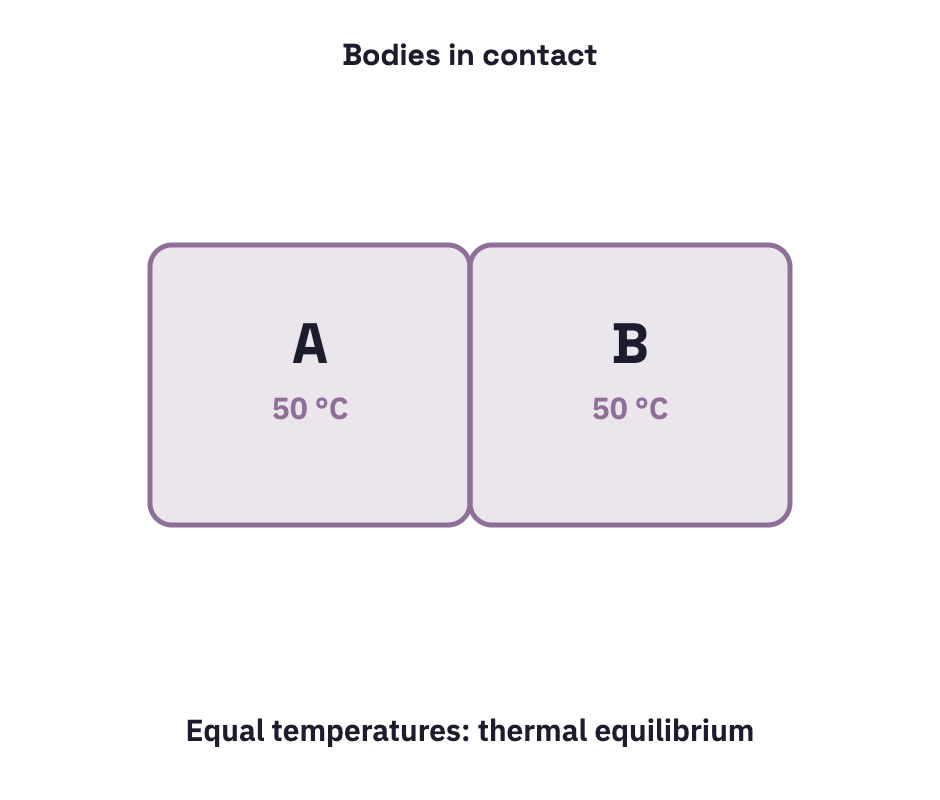
A hot body A in contact with a cold body B gives heat to B. A cools, B warms, and the flow stops when both reach one common temperature. That state, with no net heat flow, is thermal equilibrium.
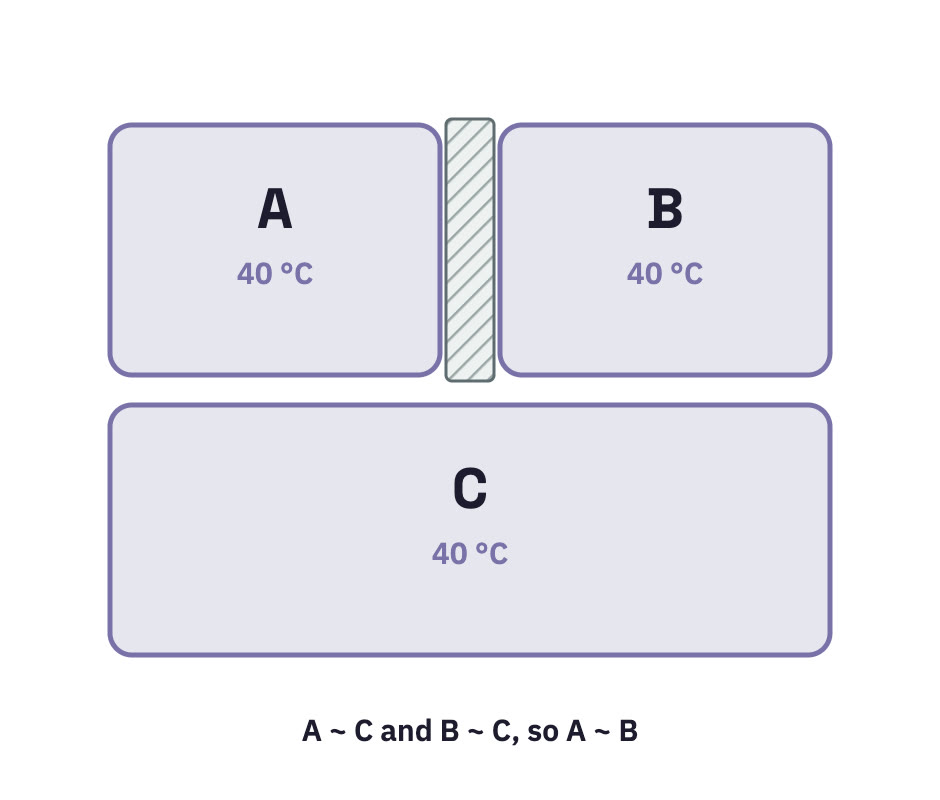
A ~ C and B ~ C ⇒ A ~ B
If A is in thermal equilibrium with C, and B is in thermal equilibrium with C, then A and B are in thermal equilibrium with each other, even if they never touch. The property they share is temperature.
A thermometer is body C
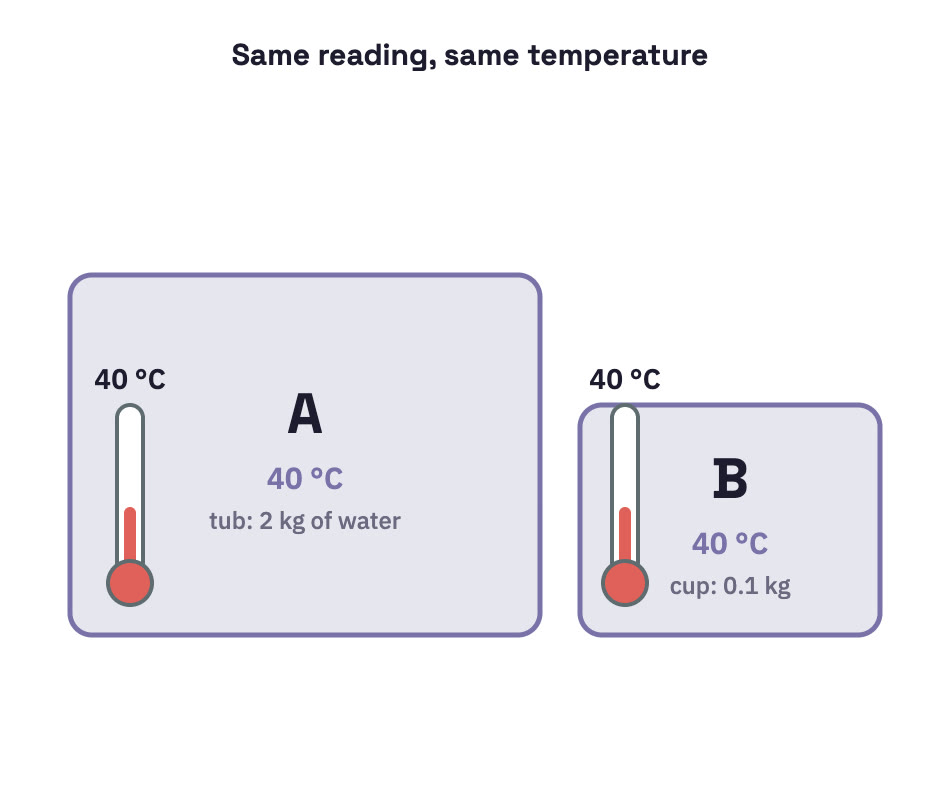
A thermometer that reads the same in A and in B tells us A and B are at the same temperature. The zeroth law is what lets us define temperature before the first and second laws use it. Equal temperature does not mean equal energy: a tub and a cup at 40 °C hold very different amounts.
One for every idea
1. Body A is in thermal equilibrium with body C, and body B is also in thermal equilibrium with C (A and B are not in contact). Are A and B necessarily in thermal equilibrium with each other? Which law guarantees this?
- Equilibrium with C means equal temperature: and .
- So : if A and B are brought together, no heat flows.
Yes. This is the zeroth law of thermodynamics.
Your turn
Bodies A and B are each in thermal equilibrium with a third body C. Which quantity must A and B have in common?
Show the answer and the traps
Temperature, option b. That is all thermal equilibrium needs.
Not heat content or internal energy: a tub and a cup at the same temperature hold very different amounts.
And not mass: equilibrium says nothing about how big the bodies are.
Common mistakes
Try these
1. A thermometer reads 36 °C in body A and 36 °C in body B. A and B are then put in contact. Which way does heat flow?
Neither way: they are at the same temperature, so they are already in thermal equilibrium (zeroth law).
2. A and B are in thermal equilibrium, but B and C are not. Can A and C be in thermal equilibrium?
No. If A ~ C as well, then , so B ~ C, which contradicts the data.