 layrd.liveLayer by Layer
- 1. Zeroth Law
- 2. First Law
- 3. P–V Diagrams & Cycles
- 4. Cv, Cp and γ
- 5. Iso-processes
- 6. Adiabatic
- 7. Free Expansion
- 8. Polytropic
- 9. Engines & Fridges
- 10. Second Law & Carnot
Isochoric, Isobaric and Isothermal Processes
Hold one quantity fixed and the first law becomes simple. This part works through the isochoric (V fixed), isobaric (P fixed) and isothermal (T fixed) processes: each one's P–V curve and its Q, W and ΔU, always with .
Builds on: Part 3 · Indicator Diagrams, State Variables and Cycles, Part 4 · Molar Specific Heats: Cv, Cp and γ.
 Video coming soon
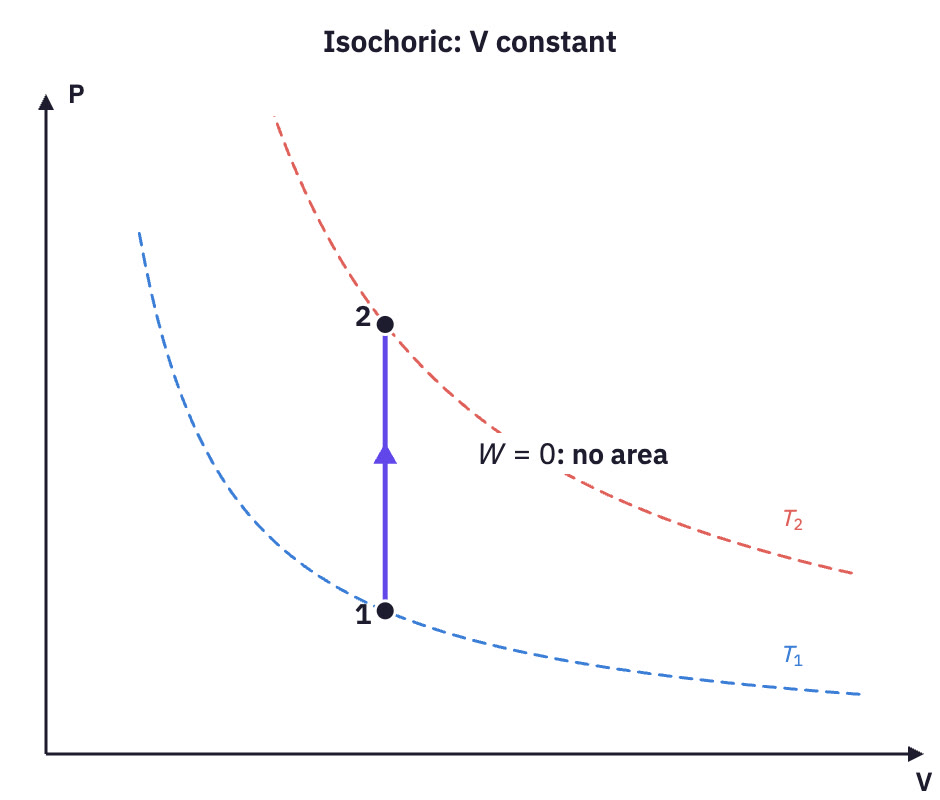
V constant:
A vertical line on the P–V diagram, with no area under it, so and . stays constant.
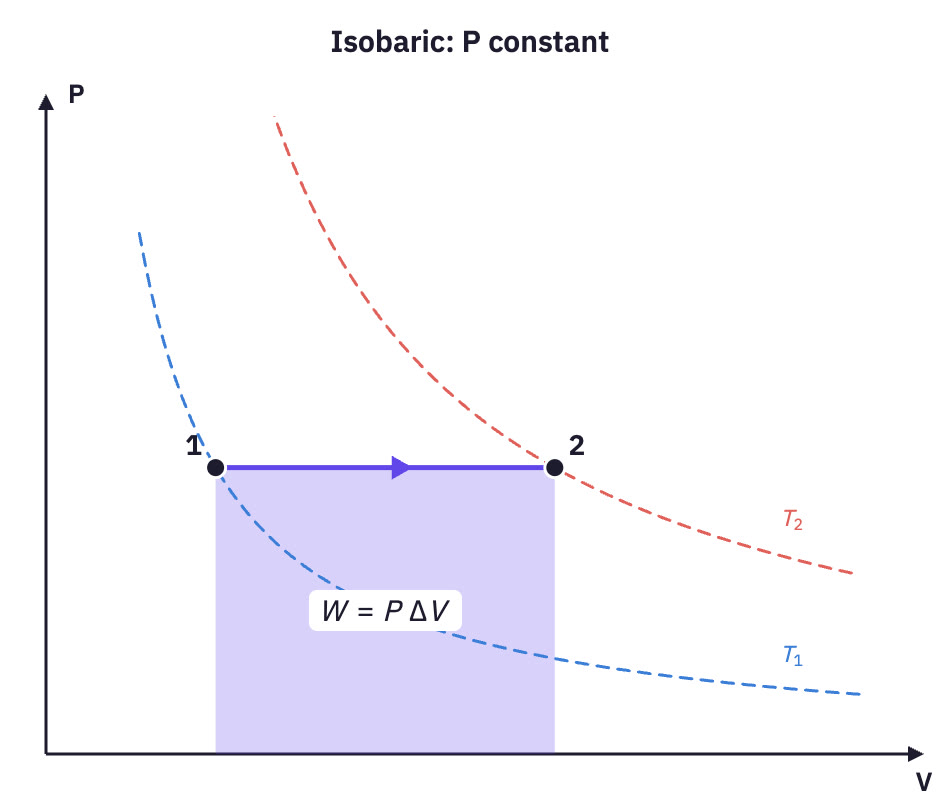
P constant:
A horizontal line; the work is the rectangle under it, . Heat , more than the isochoric heat by exactly the work.
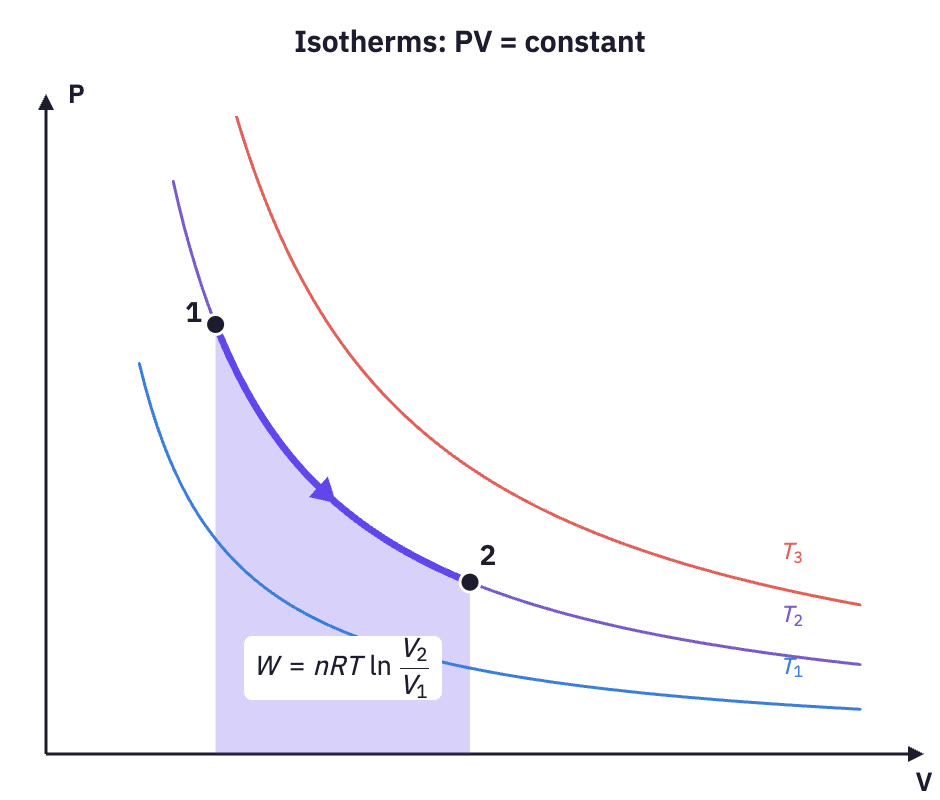
T constant:
= constant: a rectangular hyperbola, higher for higher T; isotherms never cross. , so .
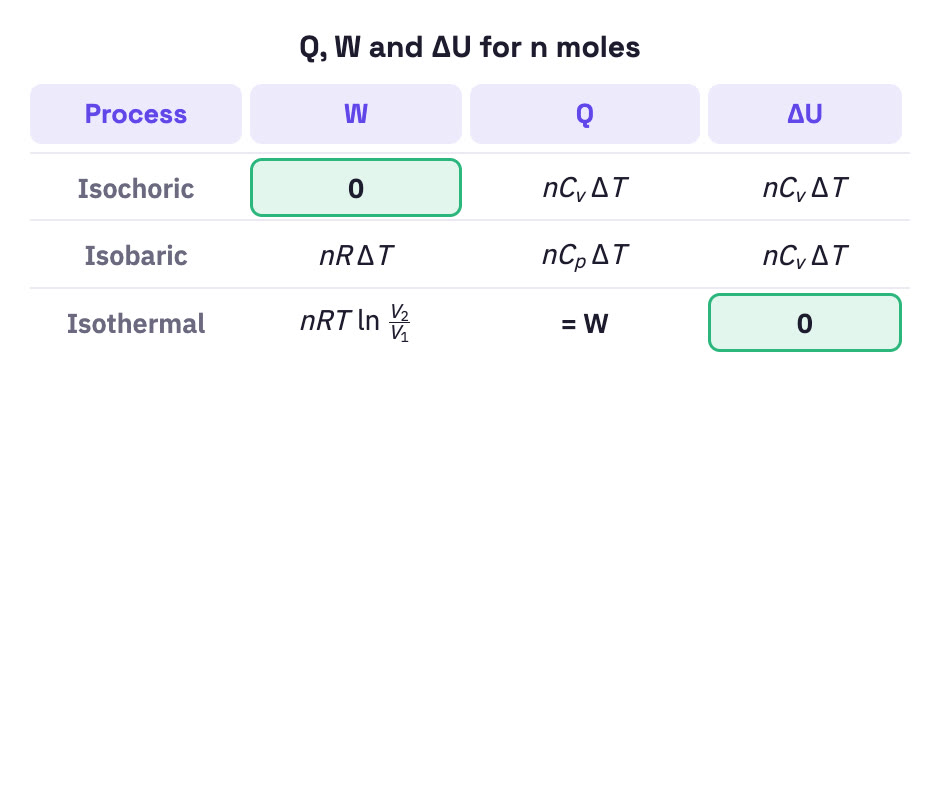
One table for all three
Isochoric: W = 0. Isobaric: W = nRΔT, Q = nCpΔT. Isothermal: ΔU = 0, Q = W. In every process , then .
Key formulas
One for every idea
1. 2 mol of a monatomic gas is heated at constant volume from 300 K to 400 K. Find the heat supplied.
- with .
- .
J, all into internal energy.
2. 1 mol of a diatomic gas expands at constant pressure from 300 K to 400 K. Find the work done by the gas.
- : no pressure or volume needed.
- .
- (Q would be J.)
J.
3. One mole of an ideal gas at 27 °C (300 K) expands isothermally until its volume doubles. Find the work done.
- .
- , so .
- Use ln: would give 751 J.
J.
Your turn
2 mol of an ideal gas expand isothermally at 300 K from 10 L to 20 L. The heat absorbed by the gas is about:
Show the answer and the traps
Q = W = nRT ln 2 = 2 × 8.314 × 300 × 0.693 ≈ 3458 J: option b.
Zero is ΔU, not Q. 1502 J uses log base 10.
And 4988 J is just nRT: it forgets the ln 2.
Common mistakes
Try these
1. At constant volume the pressure of a gas at 300 K is 2 atm. Find the pressure at 450 K.
constant: 3 atm.
2. 3 mol of a diatomic gas is heated at constant pressure from 280 K to 320 K. Find W, ΔU and Q.
J, J, J.
3. 1 mol of ideal gas at 400 K is compressed isothermally from 10 L to 5 L. Find the work done by the gas and the heat exchanged.
J; : about 2305 J of heat is released.