 layrd.liveLayer by Layer
- 1. Zeroth Law
- 2. First Law
- 3. P–V Diagrams & Cycles
- 4. Cv, Cp and γ
- 5. Iso-processes
- 6. Adiabatic
- 7. Free Expansion
- 8. Polytropic
- 9. Engines & Fridges
- 10. Second Law & Carnot
First Law of Thermodynamics
Heat a gas under a free piston and it gets hotter and pushes the piston up. The first law splits the heat into those two parts, , and this part shows how to compute each one: heat from a molar specific heat, work as an area under the P–V curve, and the internal-energy change from the temperature alone.
Builds on: Part 1 · Thermal Equilibrium and the Zeroth Law.
 Video coming soon
Heat supplied to a gas raises its internal energy and lets it do work on the surroundings. Signs: when heat goes into the gas, when the gas does work (expands), when it gets hotter. For a tiny step, .
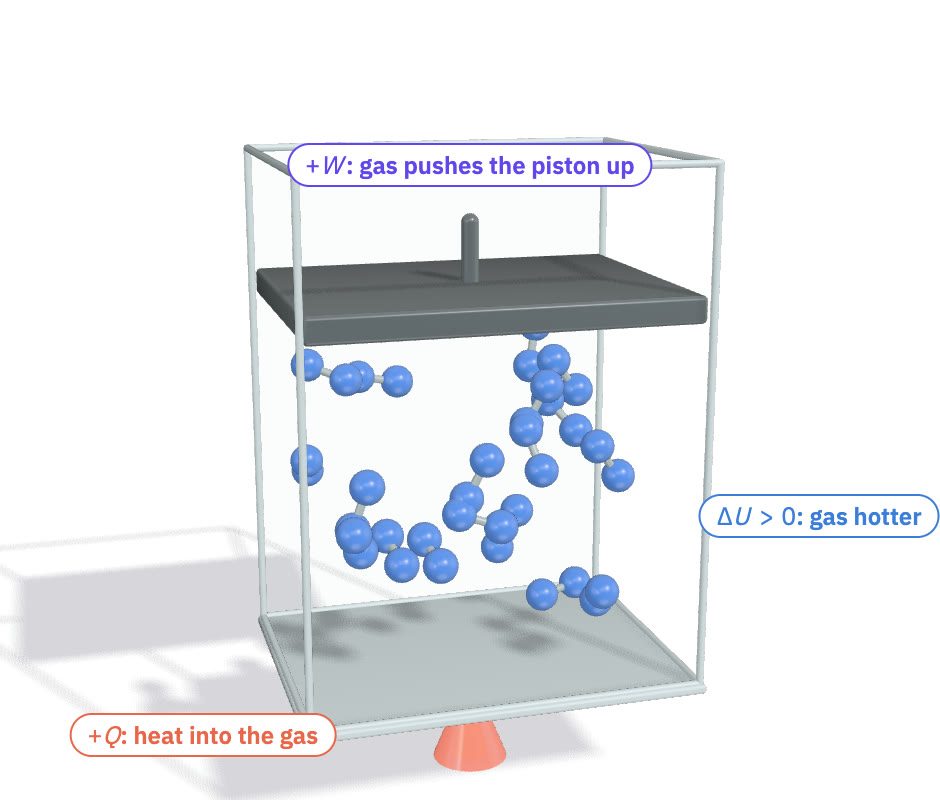
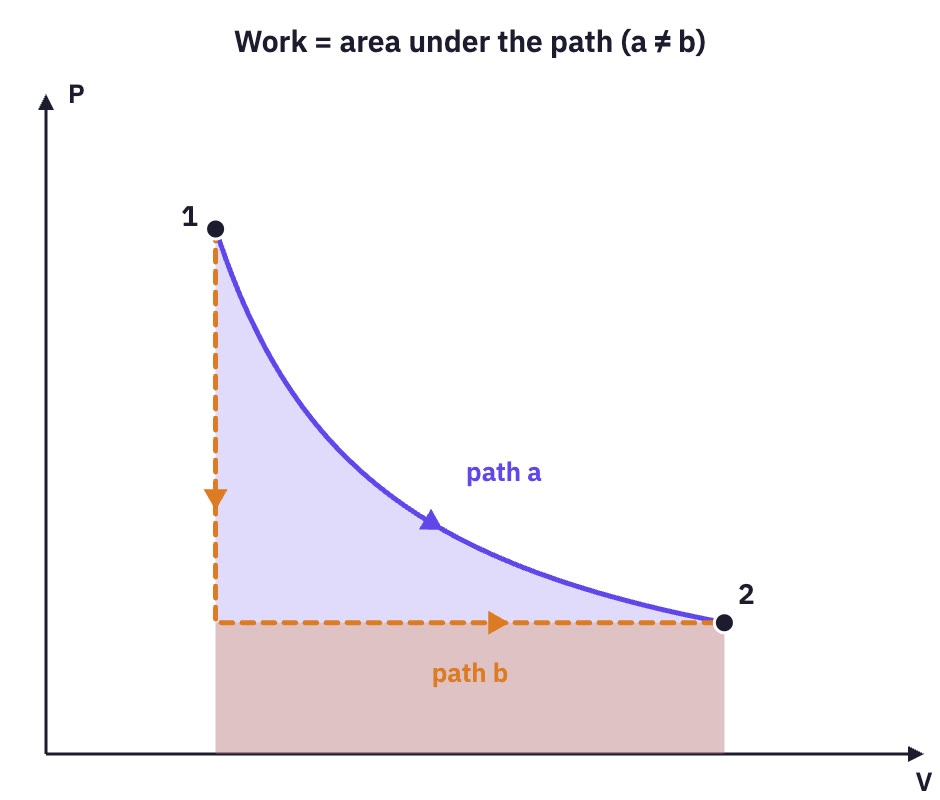
The gas pushes the piston (area S) with force ; moving it by does work . Over a process, : the area under the P–V curve. Different paths between the same states enclose different areas, so W depends on the path.
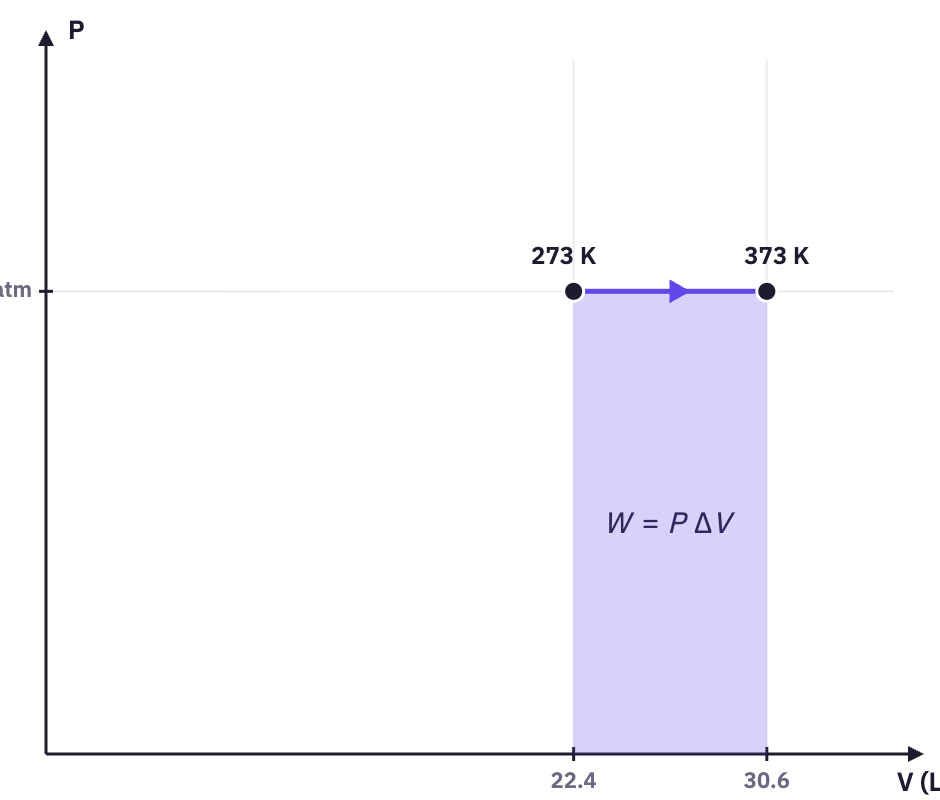
At constant pressure the area under the path is a rectangle: . For 1 mol heated by 100 K at 1 atm, J.
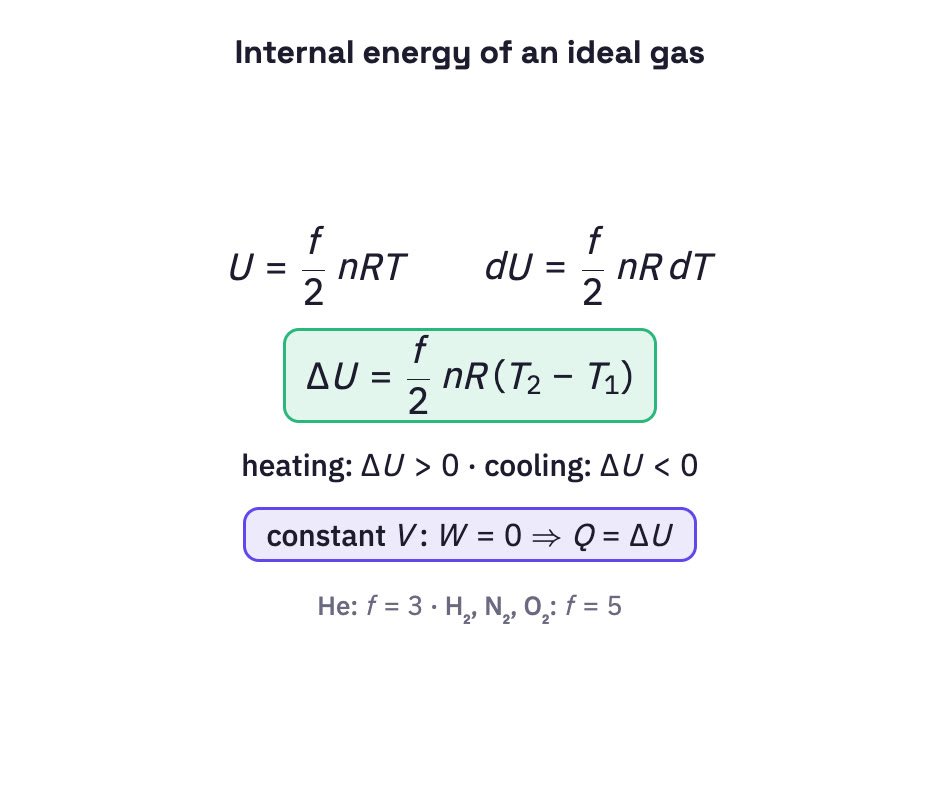
For an ideal gas depends only on temperature, so in every process. Molar specific heat C: , and a gas's C depends on the process.
Key formulas
One for every idea
1. In a process the internal energy of a system decreases by 400 J while the system does 250 J of work on its surroundings. What net heat is taken in by the system?
- Signs: J (it falls), J (done by the system).
- .
J: the system actually rejects 150 J of heat. (Illustrative Example 3.2)
2. Find the heat required to raise the temperature of 2 mol of a diatomic gas by 50 K at constant volume, given .
- J/mol·K.
- .
J (about 2.08 kJ).
3. One mole of an ideal gas is heated from 0 °C to 100 °C at a constant pressure of 1 atm. Find the work done by the gas.
- At constant pressure .
- A step of 100 °C is a step of 100 K: .
- Check with volumes: 22.4 L → 30.6 L, J.
J. (Illustrative Example 3.1; the book's 830.7 J comes from rounding the volumes.)
4. Hydrogen () at 273 K and Pa fills m³. It is cooled by 55 K at constant volume. Find the change in internal energy and the heat lost.
- mol.
- J.
- Constant volume: , so .
J and the gas loses about 252 J of heat. (Illustrative Example 3.5 gives 251.5 J with n rounded to 0.22; note the book's "STP" here is Pa.)
Your turn
A gas absorbs 200 J of heat and does 80 J of work on its surroundings. Its internal energy:
Show the answer and the traps
ΔU = Q − W = 200 − 80 = 120 J. It increases by 120 J: option b.
280 J adds the work instead of subtracting it. A decrease flips the sign.
And 200 J forgets that part of the heat left as work.
Common mistakes
Try these
1. A gas absorbs 500 J of heat and its internal energy rises by 300 J. Find the work done by the gas.
J.
2. Find the heat needed to raise 3 mol of a monatomic gas () by 20 K at constant volume.
J.
3. 2 mol of an ideal gas is heated at constant pressure from 300 K to 350 K. Find the work done by the gas.
J.
4. The temperature of 4 mol of a diatomic gas () falls from 400 K to 350 K. Find ΔU.
J.