 layrd.liveLayer by Layer
- 1. Zeroth Law
- 2. First Law
- 3. P–V Diagrams & Cycles
- 4. Cv, Cp and γ
- 5. Iso-processes
- 6. Adiabatic
- 7. Free Expansion
- 8. Polytropic
- 9. Engines & Fridges
- 10. Second Law & Carnot
Second Law and the Carnot Cycle
Engines must reject heat and refrigerators must take work, and the second law says no design can avoid it. This last part states the Kelvin–Planck and Clausius forms, then builds the Carnot cycle and its efficiency , the best any engine can do between two temperatures.
Builds on: Part 6 · Adiabatic Process, Part 9 · Reversible Processes, Heat Engines and Refrigerators.
 Video coming soon
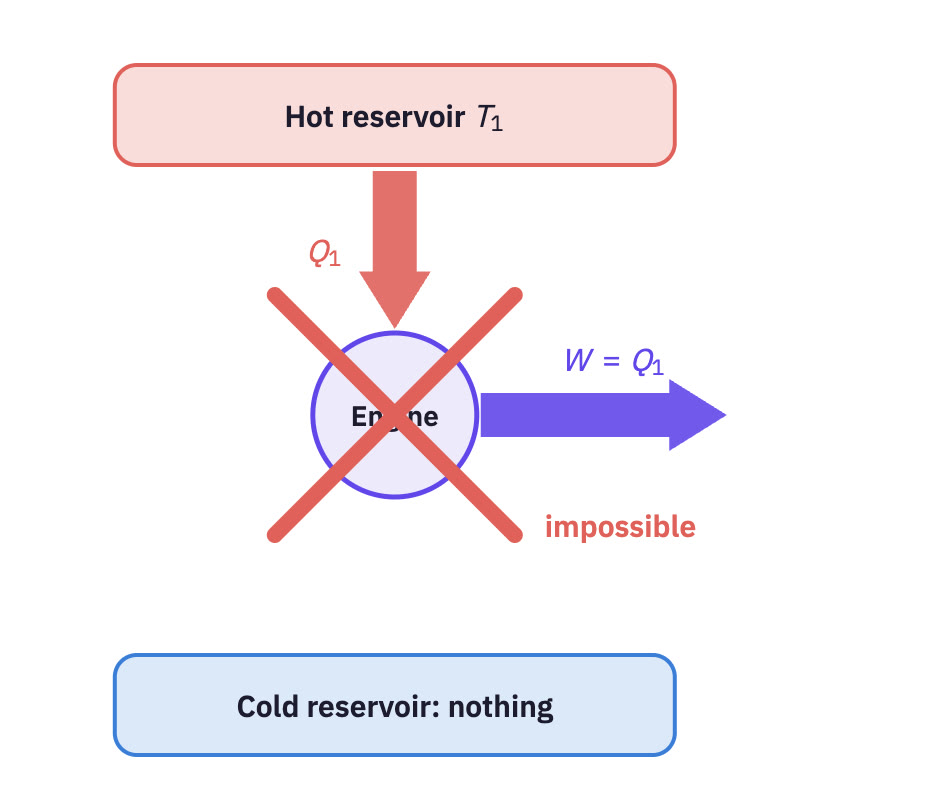
No 100% engine
No engine working in a cycle can take heat from one reservoir and convert all of it into work with no other effect. Some heat must go to a colder body.
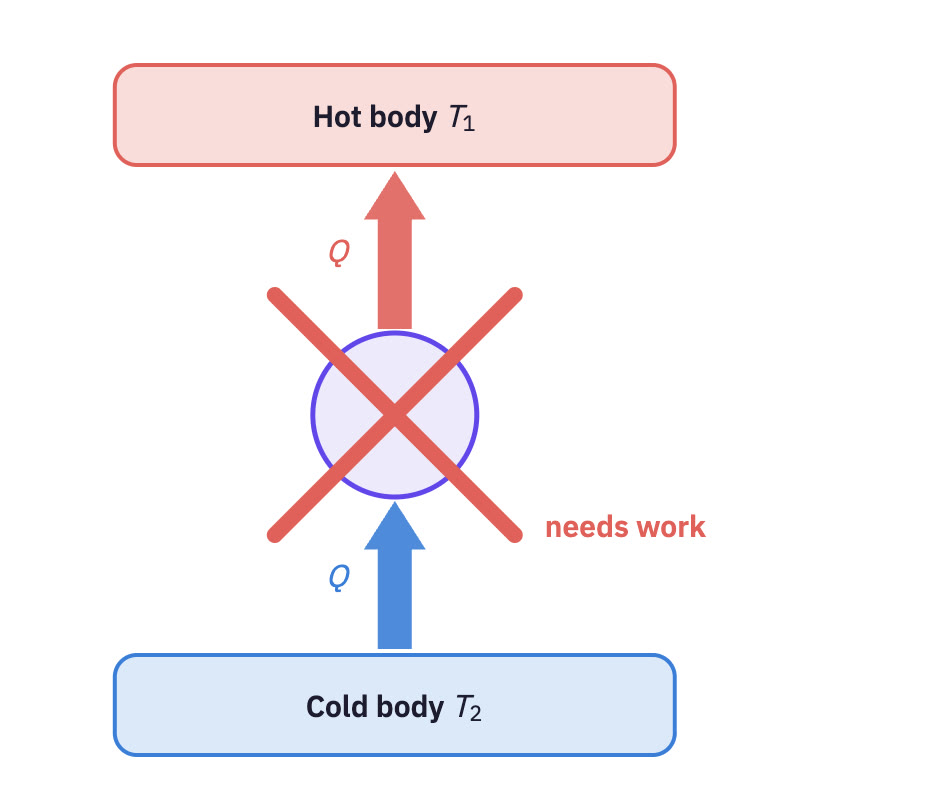
No free refrigerator
Heat cannot flow by itself from a colder body to a hotter one. The two statements are equivalent: a perfect engine driving a refrigerator would move heat from cold to hot with no outside work.
Two isotherms, two adiabats
AB isothermal expansion at ( in), BC adiabatic expansion to , CD isothermal compression at ( out), DA adiabatic compression. The adiabats make , so .
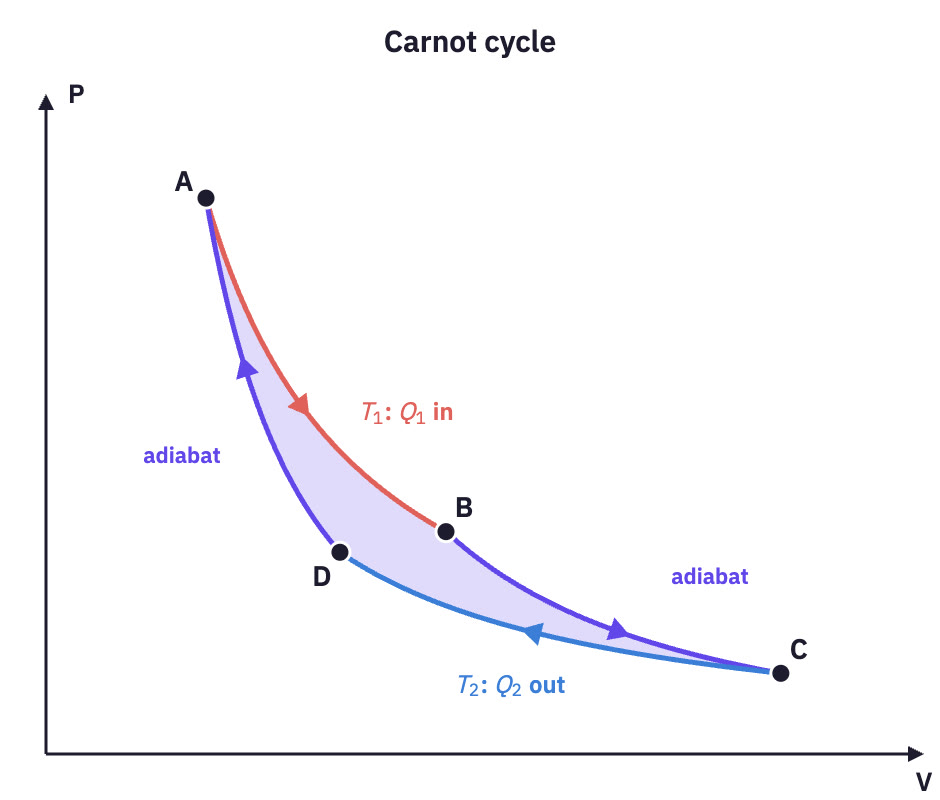
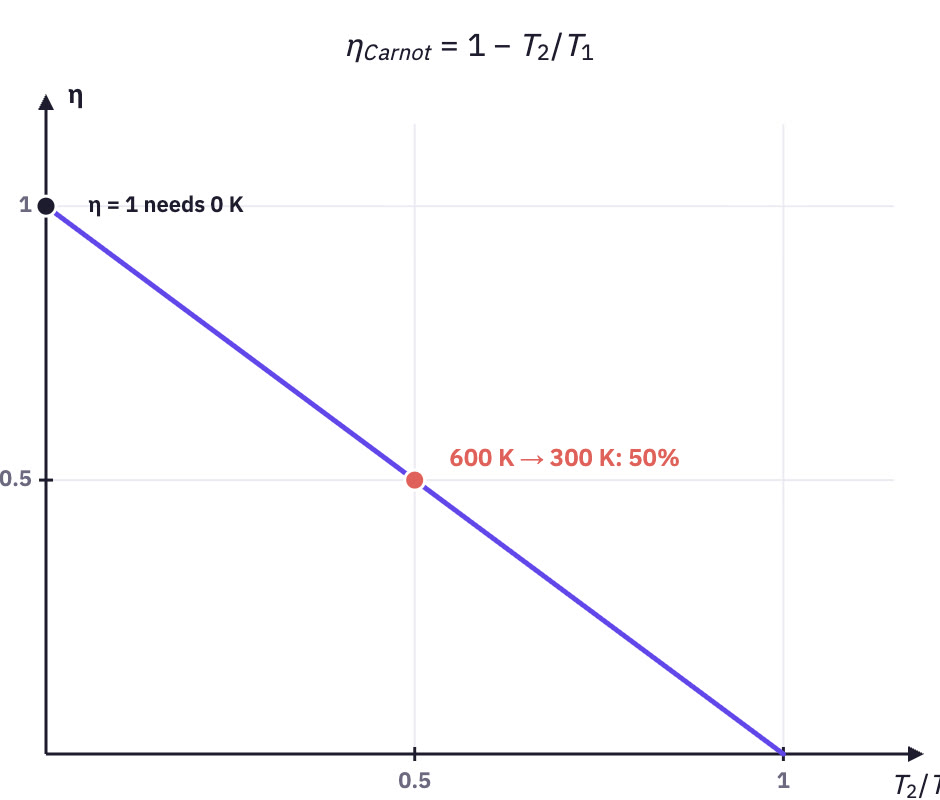
No engine between the same reservoirs can beat Carnot, and every reversible one matches it. η depends only on the temperatures (in kelvin); η = 1 would need K.
Key formulas
One for every idea
1. A proposed engine absorbs 500 J of heat from a reservoir and converts all 500 J into work, rejecting no heat anywhere. Is this possible? Which statement of the second law does it violate?
- It works in a cycle with : η = 100%.
- The first law is satisfied (500 J in, 500 J out), but the Kelvin–Planck statement forbids it.
Impossible: it violates the Kelvin–Planck statement of the second law.
2. A Carnot engine operates between a source at 600 K and a sink at 300 K, absorbing 1000 J per cycle. Find its efficiency and the work done per cycle.
- .
- ; the other 500 J goes to the sink.
- In °C, would wrongly give 92%.
η = 50%, W = 500 J.
Your turn
A Carnot engine with its sink at 27 °C has an efficiency of 40%. To raise its efficiency to 50% with the same sink, the source temperature must be raised by:
Show the answer and the traps
Sink 300 K. At 40%: T₁ = 300/0.6 = 500 K. At 50%: T₁ = 300/0.5 = 600 K. A rise of 100 K: option a.
500 K and 600 K are the two source temperatures, not the rise.
And 9 K comes from using 27 °C as if it were kelvin.
Common mistakes
Try these
1. A Carnot engine works between 127 °C and 27 °C. Find its efficiency.
.
2. A Carnot engine of efficiency 40% rejects 600 J per cycle. Find the heat absorbed and the work done.
: J, W = 400 J.