 layrd.liveLayer by Layer
- 1. Zeroth Law
- 2. First Law
- 3. P–V Diagrams & Cycles
- 4. Cv, Cp and γ
- 5. Iso-processes
- 6. Adiabatic
- 7. Free Expansion
- 8. Polytropic
- 9. Engines & Fridges
- 10. Second Law & Carnot
Indicator Diagrams, State Variables and Cycles
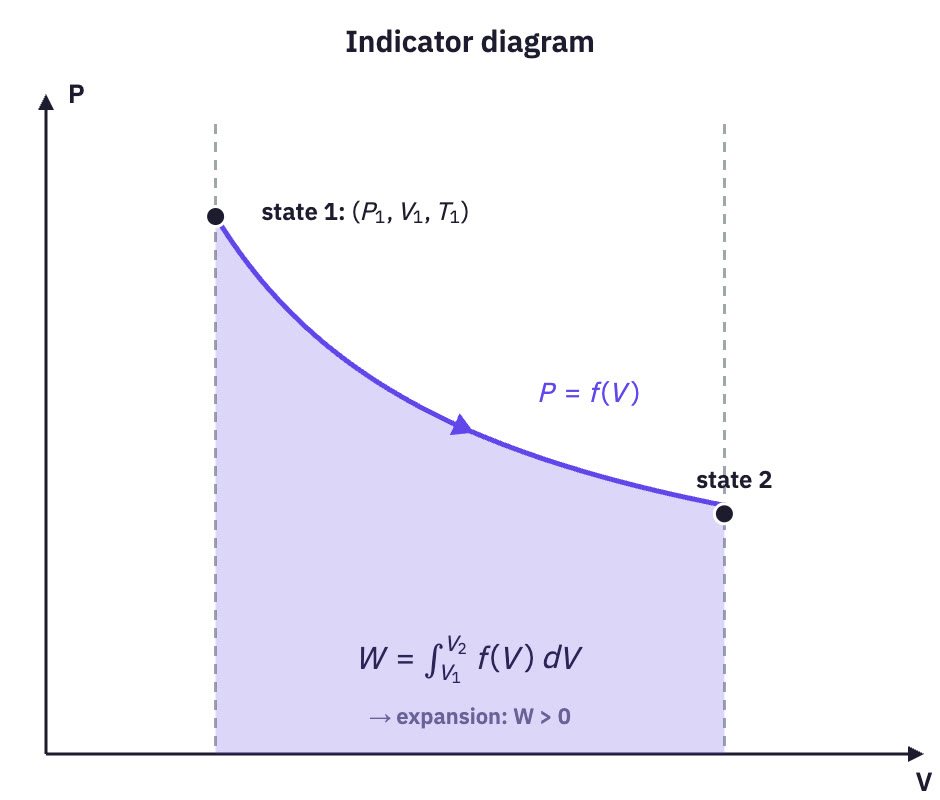
A P–V graph of a process, the indicator diagram, shows a gas's states, the path between them and the work done, all at once. This part reads it carefully: why work and heat depend on the path but internal energy doesn't, and how a closed loop gives the net work and heat of a cycle, with a sign set by its direction.
Builds on: Part 2 · First Law of Thermodynamics.
 Video coming soon
Point, curve, area
Each point is a state (, , and ). A curve is the process . The work done by the gas is the area under it: , positive for expansion and negative for compression.
Same ends, different W
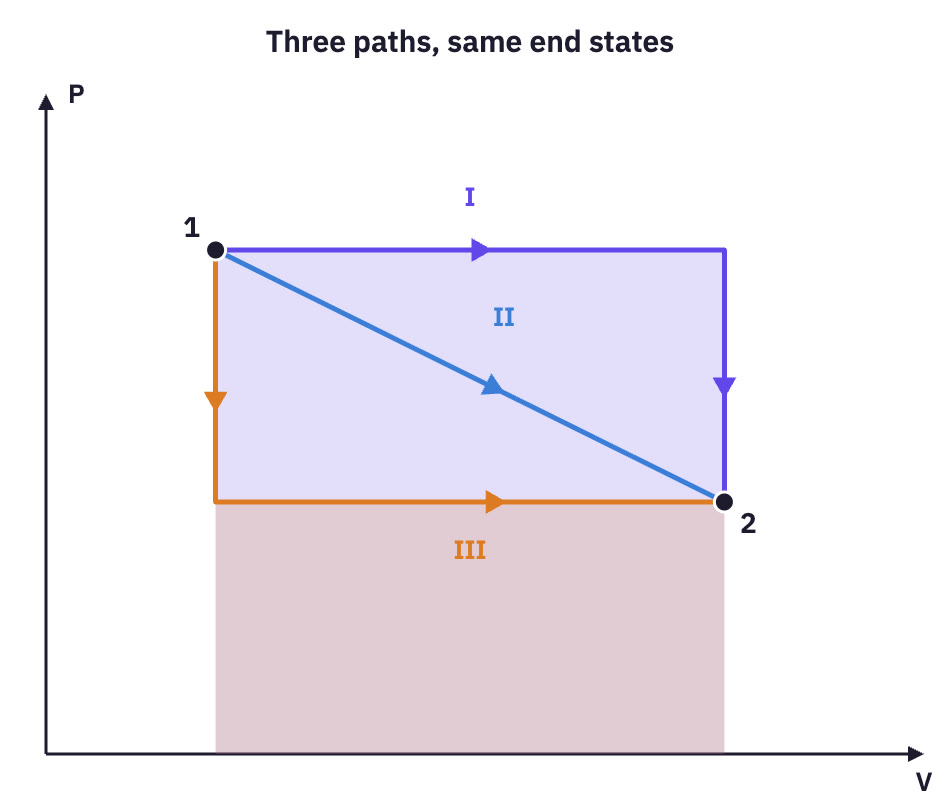
Path I (high pressure, then down) encloses more area than path III (down, then low pressure), so W differs; Q differs too. But is the same for every path: U is a state variable, Q and W are path variables.
= loop area
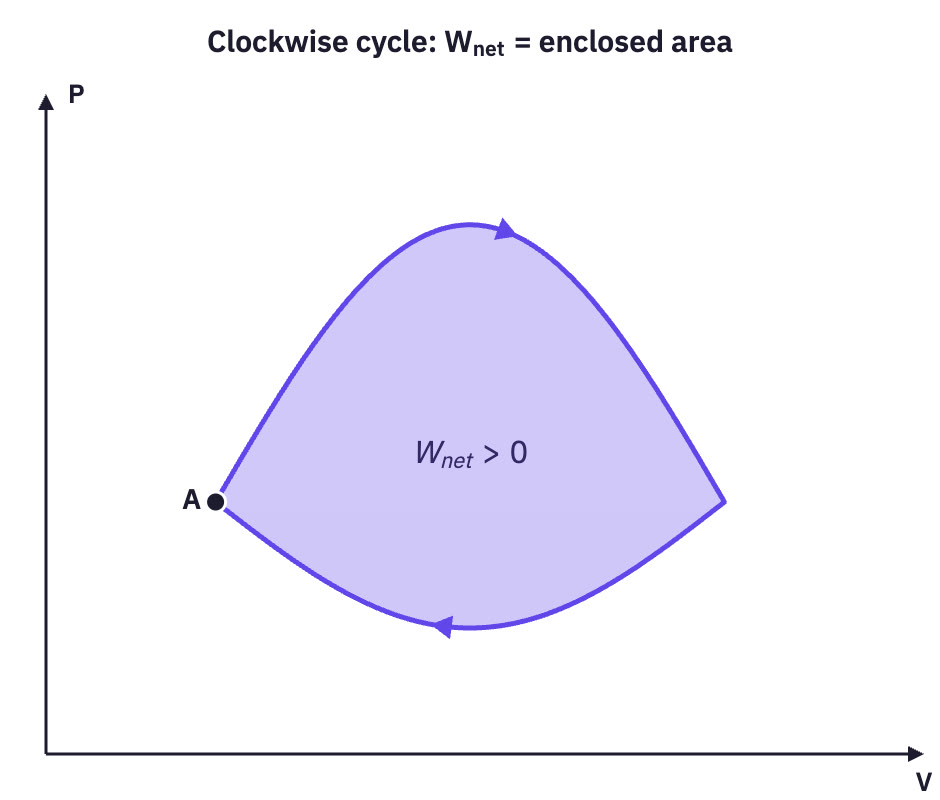
A cycle returns the gas to its start, so and , the area enclosed. Clockwise: work done by the gas, heat absorbed (engine). Anticlockwise: work done on the gas, heat rejected (refrigerator).
Anticlockwise:
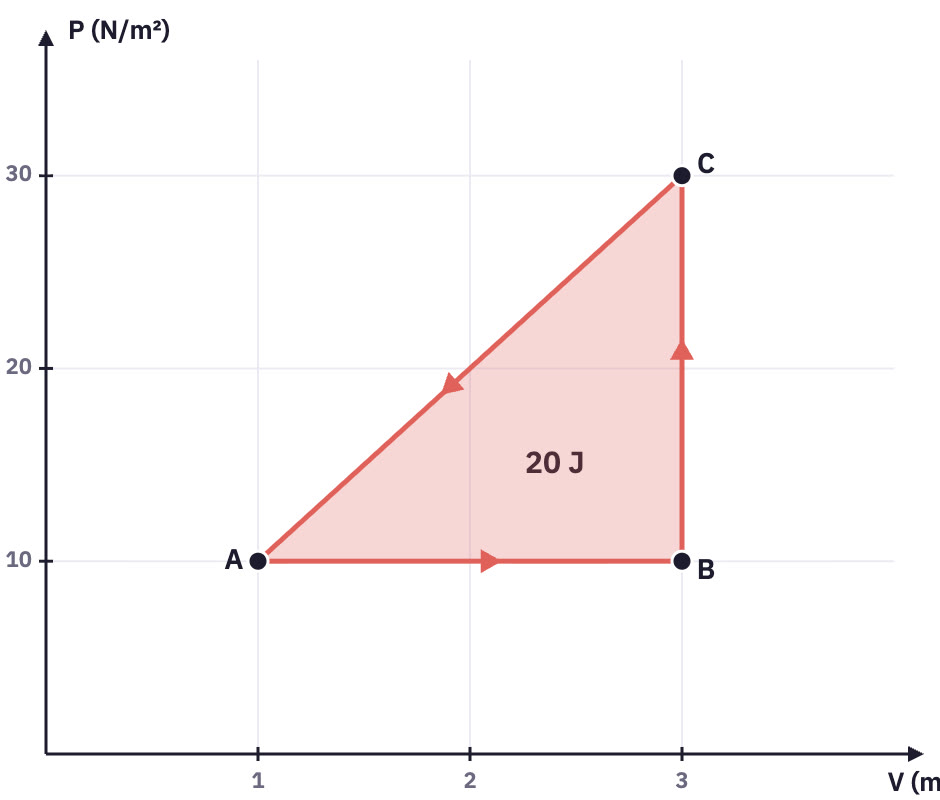
A (1 m³, 10 Pa) → B (3 m³, 10 Pa) → C (3 m³, 30 Pa) → A is anticlockwise. Area J, so J: done on the gas.
Key formulas
One for every idea
1. A gas is taken from state 1 to state 2 along two different paths on a P–V diagram. Is the work done by the gas necessarily the same along both paths?
- Work is the area under the path on the P–V diagram.
- Two different paths between the same states generally enclose different areas.
No: work depends on the path, not just the end states.
2. A system goes from state I to state F along path IAF, absorbing 55 J of heat and doing 25 J of work. Find the change in internal energy between I and F. If path IBF does 10 J of work, how much heat does it absorb?
- J.
- ΔU is the same along IBF: .
J for any path; along IBF, J. (Illustrative Example 3.6)
3. One mole of an ideal gas goes round the cycle ABCA on a V–T diagram: AB at constant volume from 300 K to 500 K; BC isothermal at 500 K until the volume is 5/3 of its starting value; CA a straight line through the origin back to A. Find the net heat supplied in one cycle.
- CA is a line through the origin on a V–T graph, so V ∝ T: constant pressure. (5V₀/3 at 500 K matches V₀ at 300 K.)
- AB: . BC: . CA: .
- ; ΔU = 0 over the cycle, so .
J. (The chapter JSON's version of Illustrative Example 3.9 describes legs that can't form a cycle; its 2146 J uses a volume ratio of 5/2 from the book's figure. This consistent cycle teaches the same method.)
4. In a cycle ABCA, A = (1 m³, 10 N/m²), B = (3 m³, 10 N/m²), C = (3 m³, 30 N/m²), traced A → B → C → A. Find the net work done and say whether it is done by or on the gas.
- Area of the triangle J.
- A → B → C → A is anticlockwise on the P–V plane.
- Check: AB +20 J, BC 0, CA −40 J.
J: 20 J of net work is done on the gas. (Illustrative Example 3.7)
Your turn
A gas goes round a cycle that is anticlockwise on its P–V diagram and encloses an area of 50 J. Over one complete cycle:
Show the answer and the traps
Anticlockwise: 50 J of work is done on the gas. ΔU = 0, so Q = W = −50 J. The gas gives out 50 J of heat: option c.
Option a is the clockwise cycle. Option b flips the sign of the heat.
And ΔU is zero over any complete cycle, never −50 J.
Common mistakes
Try these
1. A gas expands from 2 m³ to 5 m³ at a constant pressure of 100 Pa. Find the work done by the gas.
J.
2. From state A to B along path 1, a gas absorbs 80 J and does 30 J of work. Along path 2 it does 10 J of work. Find the heat absorbed along path 2.
J, so J.
3. A gas goes round a clockwise rectangular cycle between V = 1 and 3 m³ and P = 100 and 300 Pa. Find the net heat absorbed per cycle.
Area J .
4. Over one cycle a gas absorbs 900 J of heat and rejects 600 J. Find the net work done by the gas.
, so J.