 layrd.liveLayer by Layer
- 1. Zeroth Law
- 2. First Law
- 3. P–V Diagrams & Cycles
- 4. Cv, Cp and γ
- 5. Iso-processes
- 6. Adiabatic
- 7. Free Expansion
- 8. Polytropic
- 9. Engines & Fridges
- 10. Second Law & Carnot
Free Expansion of a Gas
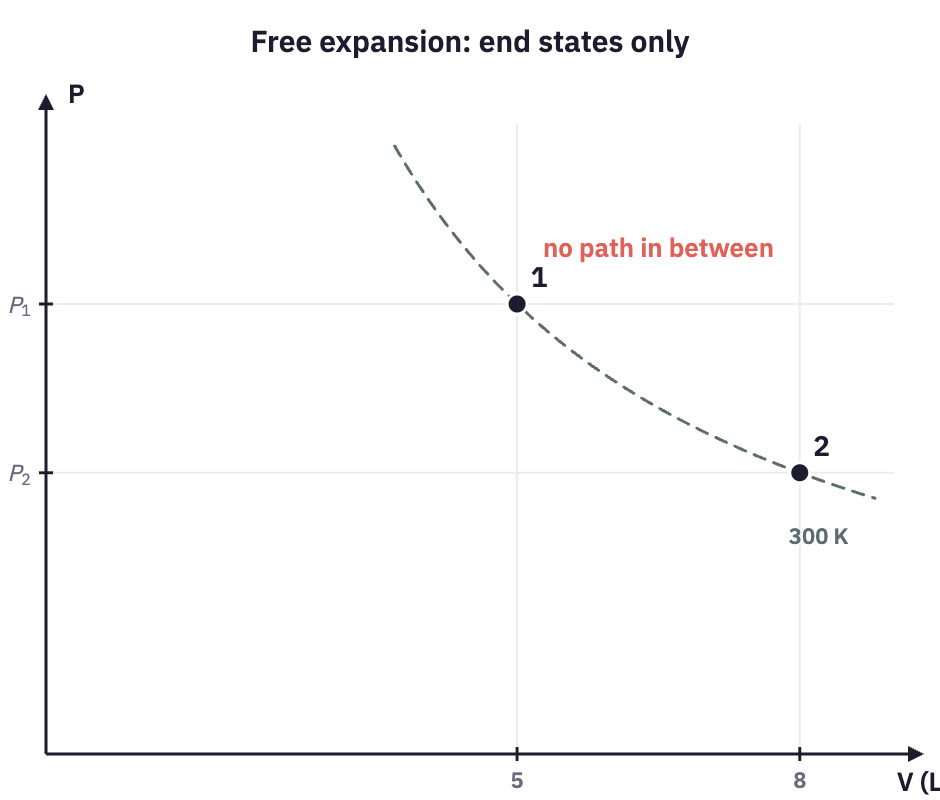
Let a gas rush into a vacuum inside an insulated vessel. It pushes against nothing and exchanges no heat, so and an ideal gas keeps its temperature. The end states obey Boyle's law, but the process itself is irreversible and has no path on a P–V diagram.
Builds on: Part 5 · Isochoric, Isobaric and Isothermal Processes, Part 6 · Adiabatic Process.
 Video coming soon
Gas | valve | vacuum
An insulated vessel holds gas on one side and vacuum on the other, separated by a valve.
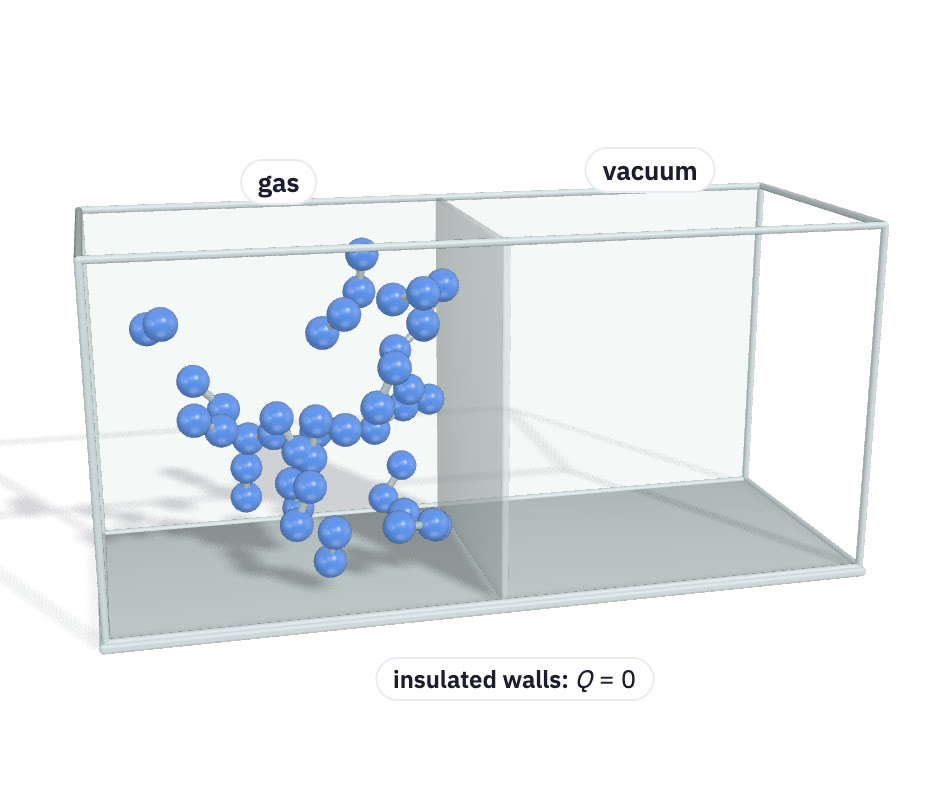
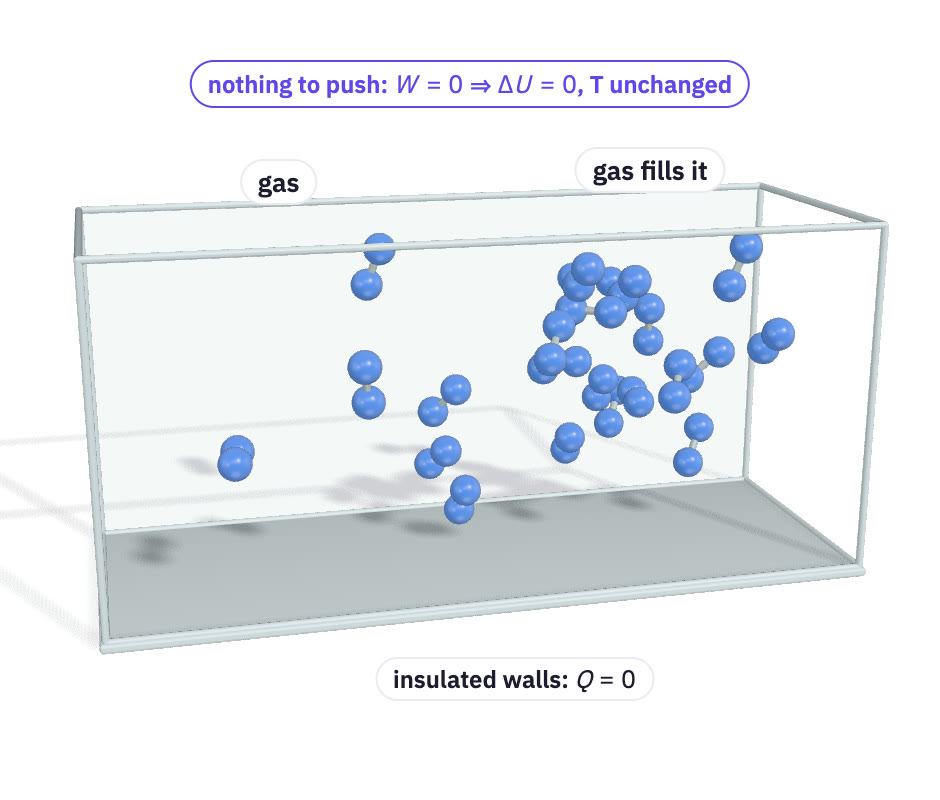
The gas expands into the vacuum with nothing to push, so ; it is insulated and fast, so . Then and, for an ideal gas, T is unchanged.
Same T at start and end, so the end states obey Boyle's law. In between, the gas has no single P or T: there is no path, and the process is irreversible. It is not an isothermal process, and does not apply.
Key formulas
One for every idea
1. An ideal gas occupies 5 L at 300 K and Pa in a thermally insulated cylinder. A valve opens to an evacuated chamber and the gas freely expands to a total volume of 8 L. Find the final temperature and pressure.
- Free expansion: , , so and T stays 300 K.
- Boyle for the end states: .
K, Pa.
Your turn
An ideal gas at 27 °C, in a thermally insulated vessel, expands freely into a vacuum until its volume doubles. Its final temperature is:
Show the answer and the traps
Q = 0 and W = 0, so ΔU = 0 and T stays 27 °C: option a.
Halving the temperature, in °C or in kelvin, has no basis. −46 °C uses the adiabatic law, which is the wrong process.
Common mistakes
Try these
1. An ideal gas at 2 atm in an insulated vessel expands freely into an equal evacuated vessel. Find the final pressure and the change in temperature.
1 atm; no change in temperature.
2. In the free expansion of an ideal gas, which of Q, W, ΔU, P, V and T change?
Only P (falls) and V (rises). Q = W = ΔU = 0 and T is unchanged.